
Built to Adapt Pt 2
Mar 25, 2026You Don’t Have an Energy Problem
Last week, we started this series by talking about neuroplasticity and how your brain is constantly adapting to the way you live. Whether you realize it or not, it is always changing, always rewiring, always responding to the inputs you give it. That idea alone is powerful, because it means you are not stuck. You are always capable of change. This week, I want to zoom out a bit and look at another system that is just as incredible, and maybe even more overlooked.
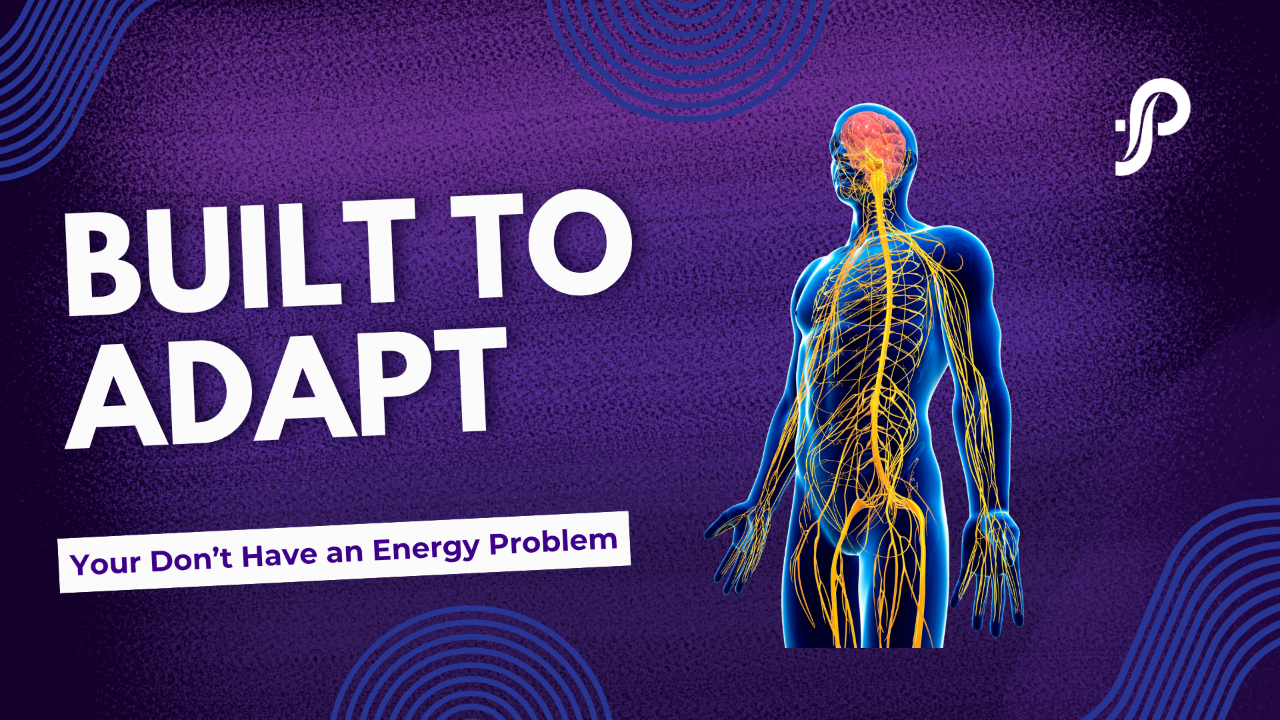
There is something happening inside your body every second of every day that most people never think about. Your nervous system is constantly monitoring your environment and deciding how your body should respond. It is adjusting your heart rate, your breathing, your muscle tension, your focus, your energy, all in real time. It is taking in information from the world around you and making thousands of decisions to keep you alive, functioning, and prepared for whatever comes next. And the most amazing part is that you don’t have to think about any of it. It just happens.
At a very simple level, your nervous system is always shifting between two primary states. One is designed for action. It prepares you to move, to respond, to handle stress, to deal with challenges. This is often referred to as the “fight or flight” side of your system. The other is designed for recovery. It allows you to slow down, digest, repair, and restore. This is the state where your body rebuilds, where your brain resets, where real recovery happens. Both of these states are necessary, and you are meant to move between them throughout the day.
When everything is working well, there is a natural rhythm to it. You encounter something stressful, your body rises to meet it, and then once it passes, the system comes back down. Your breathing slows, your muscles relax, your body shifts into recovery mode. It is a beautifully designed system, responsive, efficient, and intelligent, always trying to keep you in balance. But for a lot of people, that rhythm gets disrupted. The system still rises, but it doesn’t fully come back down, and over time, that starts to feel like something is wrong.
This is where that familiar feeling begins to show up. You feel tired, but you can’t relax. You want to rest, but your mind keeps going. You wake up feeling like you never fully recovered. And the natural conclusion is that you must have an energy problem. But more often than not, that’s not what’s happening. The issue isn’t that your body isn’t producing enough energy. It’s that it has been living in a state that doesn’t allow it to recover.
The modern environment makes this easy to understand. We are constantly stimulated, constantly connected, constantly thinking about what’s next. Even the moments that are supposed to be restful are filled with input. Screens, notifications, information, noise. Your nervous system does not necessarily differentiate between a physical threat and a psychological one. It simply responds to the signal. And if the signal is always telling it to stay alert, stay ready, stay on, then that becomes the baseline.
This is where things begin to show up in ways people don’t always expect. It is not just mental overwhelm. It is poor sleep, inconsistent energy, difficulty focusing, and a sense of being drained even when you feel like you are doing everything right. And this is where I see a lot of people get stuck, especially when it comes to fitness. Because in the fitness world, the message is often simple. Work harder. Push more. Sweat more. Do the most intense thing possible. There is this belief that if a workout leaves you exhausted, it must be effective.
But what I see all the time is people stacking high-intensity workouts on top of an already stressed system. CrossFit, HIIT classes, spin. All of these can be great tools, but they are also stressors. If someone’s nervous system is already living in a constant state of high alert, adding more intensity without enough recovery doesn’t fix the problem. It amplifies it. I have worked with a lot of people who feel like they are doing everything right. They are consistent, they show up, they push themselves, and they work hard. But they are also exhausted. Their sleep is off, their energy is inconsistent, and their progress stalls. And the instinct is to do more. More workouts, more intensity, more effort. But sometimes the most effective thing you can do is not more. It is different.
The body does not just respond to effort. It responds to the type of stress you apply and whether it has the ability to recover from it. If every input is high intensity, high demand, and high output, the system never gets a chance to return to baseline. Over time, that begins to affect everything. Hormones, recovery, energy levels, even mood. Not because exercise is bad, but because the body is adapting to the environment it is given. This is the part that often gets missed. A workout being hard does not automatically mean it is effective. The right workout is the one your body can adapt to positively, one that challenges you but also allows you to recover, one that builds you up instead of constantly breaking you down. And that looks different for everyone, depending on your lifestyle, your stress levels, your sleep, and your current capacity.
This idea extends far beyond fitness. Your nervous system is responding to everything. Your work, your environment, your habits, your inputs throughout the day. It is constantly asking what state it needs to be in to handle what is in front of it. And if the answer is always to stay on, stay alert, stay ready, then eventually, that becomes where you live. But just like everything we will talk about in this series, this system is adaptive. It can change. You do not need to remove all stress from your life. That is not realistic, and it is not the goal. The goal is to create moments where your body can shift out of it, moments where it can recover, slow down, and feel safe enough to return to baseline.
I have had to learn this in my own life. There were times where I thought I needed more discipline, more effort, more intensity. But what I actually needed was balance. Less constant input, more intentional movement, and more awareness of how I was living day to day. And when that shifted, everything else started to follow. This is the bigger picture. Your body is not working against you. It is constantly adapting to the signals you give it. If those signals are always pushing, always stimulating, always demanding, your body will rise to meet that. But if you begin to give it space to recover, to regulate, and to shift, it will adapt to that too.
So instead of asking why you are so tired, it might be more helpful to ask what state your body has been living in.
In next week’s Built to Adapt blog post, we will explore the immune system, one of the most misunderstood systems in the body and one that is constantly working behind the scenes to protect you, often in ways that people interpret as something going wrong.
Don't miss a beat!
New moves, motivation, and classes delivered to your inbox.
We hate SPAM. We will never sell your information, for any reason.