
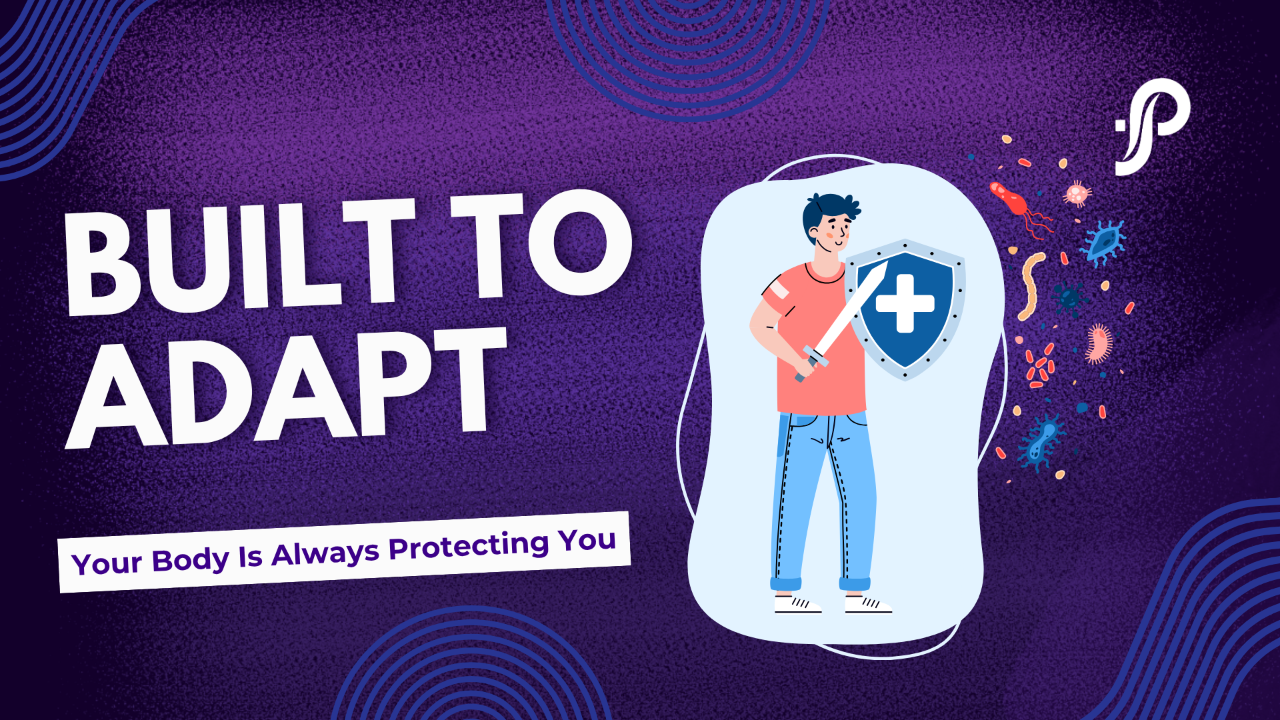
Built to Adapt Pt 3
Mar 31, 2026Your Body Is Always Protecting You
Last week, we talked about the nervous system and how your body can get stuck in a constant state of “on,” always alert, always ready, even when there is no real threat in front of you. That alone starts to shift how you see your body. It’s not random, and it’s not failing. It’s responding. It’s adapting to the environment you give it. This week, we’re going to take that idea one step further and look at another system that is constantly working behind the scenes, protecting you in ways most people never stop to consider.
Your immune system is always working. Every second of every day, it is scanning, identifying, responding, and protecting you from potential threats. It is managing bacteria, viruses, damaged cells, and internal changes without you ever having to think about it. It is one of the most complex and intelligent systems in the human body, and yet most people only think about it when something feels wrong. When they get sick, when they feel run down, when inflammation shows up, the assumption is that the immune system is failing or malfunctioning in some way.
But more often than not, what you are feeling is not failure. It is response.
The immune system is not passive. It does not sit around waiting for something to go wrong. It is constantly active, constantly learning, and constantly adapting to what it is exposed to. When you get sick, that is not your body breaking down. It is your body recognizing a threat and mounting a response. When inflammation increases, that is not always something to suppress immediately. It is often a signal that your body is trying to repair, contain, or defend against something it has identified as a problem. Even fatigue, which people often resist or try to push through, can be part of that response. Your body is asking for energy to be redirected toward healing.
This is where it can be helpful to start looking at common symptoms a little differently. A headache, for example, is often something people immediately try to shut down, and sometimes that makes sense in the moment. But it can also be a signal. Dehydration, poor sleep, stress, tension, or even too much screen time can all contribute. The headache itself is not the root problem, it is your body communicating that something is off. The same can be said for fatigue, getting sick more frequently, or feeling run down. These are not random inconveniences. They are often signs that your system is under strain and asking for support. That does not mean you should never use tools to manage symptoms, but if the response is always to silence them without asking why they are happening, you miss the opportunity to actually address what is driving them in the first place.
This is what makes the immune system so fascinating. It is not just a defense system. It is a learning system. It adapts based on exposure, based on environment, and based on how you live. It is constantly updating its playbook, becoming more efficient at recognizing and responding to what it encounters. In many ways, it mirrors what we talked about with the brain. It gets better at what it practices.
And that is where the conversation starts to get more nuanced.
We live in a time where there is a strong emphasis on protection from the outside. Avoid exposure, eliminate risk, control the environment as much as possible. And while there is absolutely a place for that, especially in certain situations, it can sometimes lead to a misunderstanding of how the body actually builds resilience. Because the immune system does not become strong by avoiding every challenge. It becomes capable by learning how to respond to them.
That does not mean that all stress is good, or that more exposure is always better. Just like we talked about with the nervous system, there is a balance. Too much stress, too frequently, without proper recovery can overwhelm the system. But the complete absence of challenge does not help it grow either. The immune system thrives in an environment where it is supported, where it is challenged appropriately, and where it has the resources it needs to respond effectively.
This is where lifestyle becomes so important, even though it is often overlooked. Sleep, nutrition, movement, and stress all directly influence how your immune system functions. If someone is consistently under-slept, highly stressed, not moving their body, and not fueling themselves well, the immune system does not have the same capacity to respond. Not because it is broken, but because it is operating under constant strain. On the other hand, when the body is well-supported, when recovery is prioritized, when movement and nutrition are aligned, the immune system becomes more efficient, more responsive, and more resilient over time.
I see this play out all the time. Someone feels like they are getting sick frequently, or that their body is constantly “off,” and the assumption is that something deeper must be wrong. But when you zoom out and look at how they are living, the picture starts to make more sense. Poor sleep, high stress, inconsistent routines, constant stimulation. The immune system is not failing. It is working overtime in an environment that makes its job more difficult.
This is also where conversations around medical interventions, including vaccines, tend to get flattened into something much simpler than they actually are. They’re often framed as a clear, one-size-fits-all solution- something you either fully accept or fully reject. But the human body isn’t simple, and neither is the immune system.
Vaccines can be a useful tool in certain contexts. They’re designed to introduce the immune system to a specific threat in a controlled way, so it can recognize and respond more efficiently if it encounters that threat again. That can matter in the right situation.
But they are still just one input.
And when one input becomes the center of the conversation, it can quietly shift how people think about health. It can create the impression that protection is something external - something you receive - rather than something you build. Over time, that mindset matters.
Because once you start looking at it that way, you begin to notice a broader pattern. The default response becomes reaching for a solution instead of asking what the body actually needs. And the risk there is not the tool itself. It is losing sight of the system.
Your immune system is not passive. It is adaptive. It learns through exposure, through environment, through the accumulation of experiences over time. It responds to your sleep, your nutrition, your stress, your movement, and the countless interactions your body has with the world every day. That is what shapes resilience.
So the more useful question is not whether one thing is good or bad.
It is what role that thing plays in the bigger picture of a system that is meant to adapt.
Because long-term health is not built from a single intervention. It is built from how the entire system is supported over time.
There are even situations within the body that highlight just how complex and intelligent this system is, even when it does not appear that way on the surface. In some cases, the body attempts to isolate or contain abnormal cell growth rather than allowing it to spread freely. From the outside, this can look like something has gone wrong, but internally it can represent an effort to manage and control a situation that the body has identified as a threat. This does not mean the process is perfect, or that intervention is not sometimes necessary, but it does point to a deeper truth. The body is not passive in these situations. It is actively trying to respond.
This is really the shift in perspective that matters. Your body is not fragile. It is not constantly on the verge of failure. It is incredibly intelligent, incredibly responsive, and always working to maintain balance based on the inputs it receives. When you begin to understand that, the conversation changes. Instead of immediately asking what is wrong, you start asking what your body is responding to. Instead of trying to override every symptom, you begin to look at what those symptoms might be signaling.
And just like everything we will talk about in this series, this system is adaptive. It can change. It can become more resilient, more efficient, and more capable over time when it is supported in the right way. That does not come from a single intervention or a quick fix. It comes from how you live, day in and day out, and the environment you create for your body to operate in.
In next week’s Built to Adapt blog, we are going to shift our focus to metabolism and energy, and explore why your body is not trying to hold you back, but rather trying to keep you alive and functioning in the most efficient way possible.
Don't miss a beat!
New moves, motivation, and classes delivered to your inbox.
We hate SPAM. We will never sell your information, for any reason.