
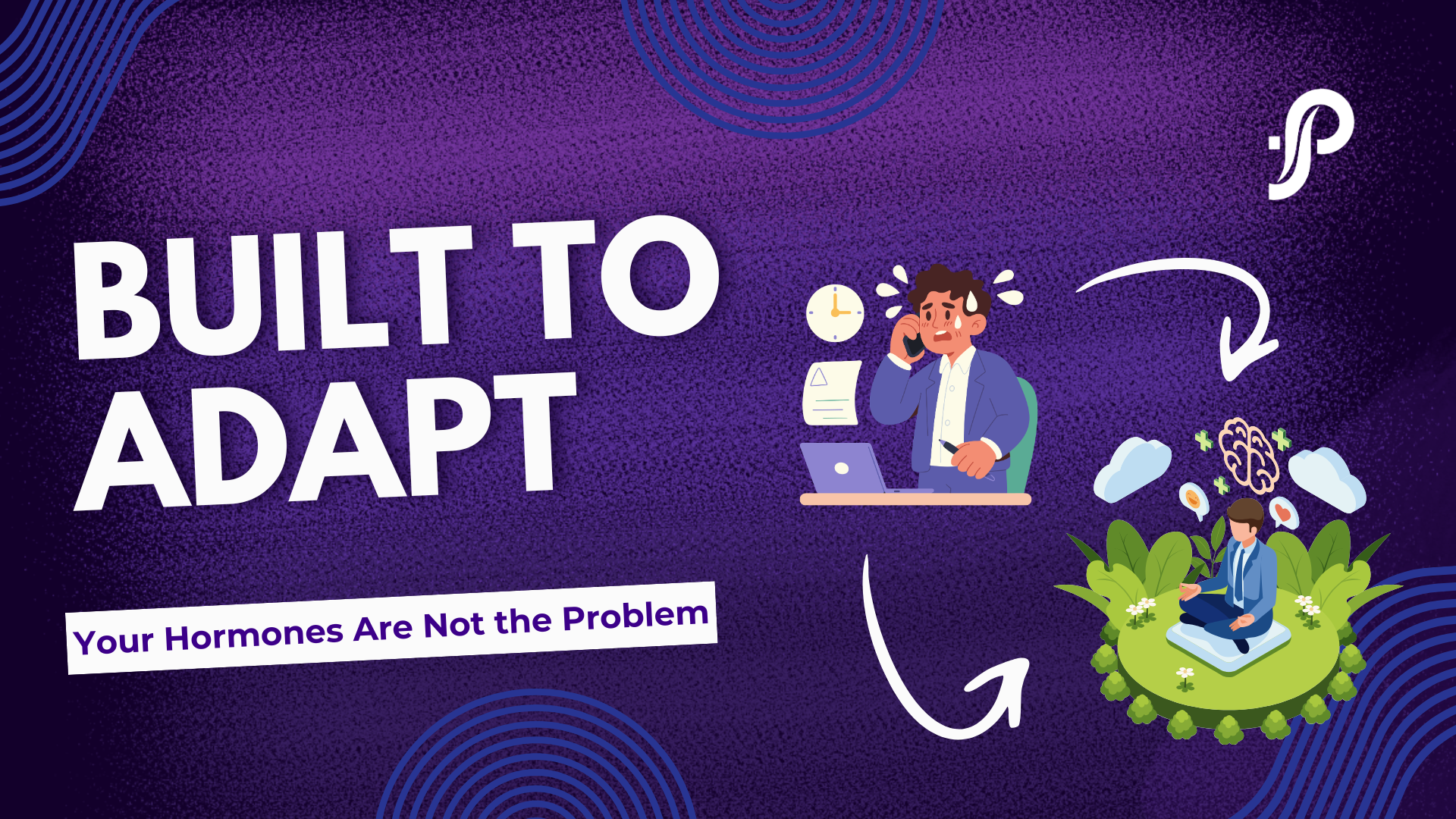
Built to Adapt Pt 5
Apr 24, 2026Your Hormones Are Not the Problem
Last week, we talked about metabolism and how your body is constantly adjusting its energy output based on how you live. That conversation starts to challenge a common belief, the idea that your body is fixed and working against you. When you begin to see metabolism as something adaptive, something that responds to your environment, it opens the door to a much bigger realization. The same is true for nearly every system in your body. This week, we’re going to apply that same lens to something that people often feel even more confused and frustrated by.
Hormones have become one of the most common explanations for why people feel “off.” Low energy, poor sleep, weight gain, low libido, and mood swings are often quickly attributed to something being wrong internally. It does not take long before the conclusion becomes that your hormones are out of balance, out of sync, or somehow working against you. But that assumption misses something important.
Your hormones are not random, and they are not acting independently. They are constantly sending signals throughout your body, coordinating how different systems respond based on what is happening internally and externally. They help regulate energy, recovery, stress, hunger, sleep, and countless other processes. In most cases, they are not the cause of the problem. They are the reflection of it.
This is where the shift in perspective begins. Instead of asking what is wrong with your hormones, it becomes more useful to ask what your hormones are responding to. Because they are always responding to something. Your sleep patterns, your stress levels, your nutrition, your movement, your body composition, and your environment all influence the signals your body sends and how those signals are interpreted.
If you are consistently under-slept, your hormonal environment will reflect that. If you are under constant stress, your body will prioritize survival over optimization. If you are not eating enough, not moving enough, or pushing your body without proper recovery, your hormonal signals will shift accordingly. This is not your body malfunctioning. It is your body adapting to the conditions it has been given.
This is why the idea of “hormone imbalance” can be misleading when it is taken out of context. It suggests that something inside you has simply stopped working, when in reality your hormones are often reacting appropriately to the environment you have created. When people zoom out and start looking at their lifestyle as a whole, the picture usually becomes much clearer. Sleep is inconsistent, stress is elevated, movement is either sporadic or excessive without recovery, and nutrition lacks consistency. The system is under pressure, and the body is responding in the only way it knows how.
When those inputs begin to change, the signals begin to change with them. This does not happen overnight, and it is not always a perfectly linear process, but it does happen consistently over time. This is what makes hormones so powerful and so misunderstood at the same time. People tend to treat them as the cause, when they are often the messenger delivering information about what is happening beneath the surface.
This does not mean that lifestyle is the only factor or that there is never a place for medical support. There are situations where deeper investigation and intervention are necessary. But what often gets overlooked is how much influence daily habits have over this system. Sleep, nutrition, movement, and stress management are not just general recommendations for health. They are direct inputs that shape how your hormonal system functions.
When those inputs are aligned, the system tends to become more stable and more responsive. When they are neglected, the system becomes more reactive and less predictable. This is where people tend to feel stuck, because the solution is not always as simple as changing one variable. It requires looking at the bigger picture and understanding that your body is constantly adapting to the conditions it is given.
That realization can feel frustrating at first, but it is also what makes it empowering. It means your body is not working against you. It is listening, responding, and adjusting in real time. Instead of seeing your hormones as the problem, you can begin to see them as information, signals that point toward what might need attention and reflect how your body is interpreting your lifestyle and environment.
Once you start to see it that way, the conversation changes. You move away from trying to control your body and toward learning how to support it. You stop asking what is wrong with you and start asking what your body is responding to. Balance is not something you force. It is something that emerges when the system is supported in the right way.
In next week’s Built to Adapt post, we’ll explore gut health and the microbiome, and how your body is not just you, but an entire ecosystem that is constantly interacting with the world around you.
Don't miss a beat!
New moves, motivation, and classes delivered to your inbox.
We hate SPAM. We will never sell your information, for any reason.