
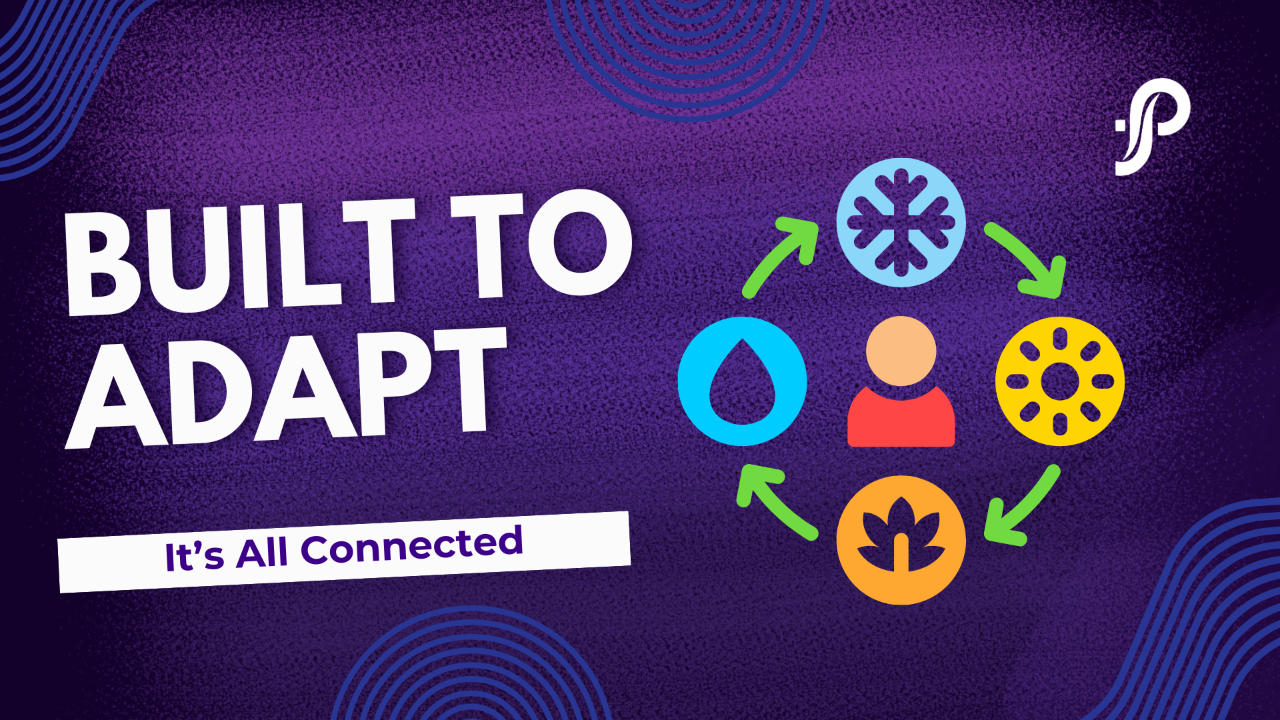
Built to Adapt Pt 8
May 12, 2026It’s All Connected
Over the past seven weeks, we’ve talked about the brain, the nervous system, the immune system, metabolism, hormones, gut health, and movement. On the surface, those topics can seem separate. Most people think about them individually. If they are tired, they think they have an energy problem. If they gain weight, they think they have a metabolism problem. If they feel anxious or depressed, they think they have a brain problem. If digestion is off, they think they suddenly developed a food intolerance. Modern health conversations tend to separate the body into isolated systems and then look for isolated solutions to match.
But the body does not work that way.
Everything is connected. Your sleep affects your hormones. Your stress affects your digestion. Your movement affects your metabolism, your brain, and your immune system. Your nutrition influences all of it. The body is constantly communicating internally and responding to the environment you create for it.
That is important to understand because most people spend their lives trying to solve symptoms without ever looking at the larger environment those symptoms are coming from. They look for the single fix. The supplement. The medication. The diet. The one thing they believe will suddenly make them feel healthy again.
And while there are absolutely tools that can help people, no single intervention can overpower a lifestyle that is consistently working against the body.
Your body is always listening. It is constantly gathering information from your environment and adjusting based on what it believes you need to survive and function. If your life is filled with chronic stress, poor sleep, low movement, ultra-processed food, alcohol, overstimulation, and nervous system overload, your body adapts to that environment. Over time, symptoms appear not because your body is betraying you, but because it is responding to the conditions it has been given.
That perspective changes everything.
Once you understand that symptoms are often signals instead of random failures, you stop seeing the body as the enemy. You stop assuming your metabolism is broken, your hormones are defective, or your brain is permanently damaged. You begin asking a different question entirely:
What is my body responding to?
That question creates ownership, and ownership is empowering. It means your daily choices matter. It means your environment matters. It means the body you have ten years from now is being shaped by the things you repeatedly do today.
That is really what this entire series has been about.
The human body is unbelievably resilient. Your brain rewires itself. Your immune system learns. Your metabolism responds to demand. Your gut constantly rebuilds itself. Your muscles strengthen or weaken depending on how you use them.
Every system is adapting all the time.
What makes all of this so fascinating to me is how unbelievably intelligent the human body really is. Most people go through life without ever realizing how much is happening beneath the surface every second of every day. Your body is constantly communicating, adjusting, repairing, protecting, and responding to the environment around it without you ever consciously thinking about it.
And yet modern health culture often reduces the body down to something fragile or malfunctioning. We are constantly encouraged to believe that every symptom needs to be silenced, every discomfort needs a prescription, and every problem has a pill attached to it.
But in many cases, what people actually need is not another product or intervention. They need a different environment.
More movement.
Better sleep.
Less chronic stress.
More real food.
More connection.
More purpose.
The body is incredibly smart, far smarter than we often give it credit for. That does not mean medicine has no place or that interventions cannot help people. Of course they can. But there is a difference between supporting the body and replacing responsibility for it. Too often, people are taught to ignore the deeper signals their body is giving them and instead search for the fastest possible way to suppress the symptom.
I see this all the time with clients dealing with aches and pains. Someone develops knee pain, shoulder discomfort, back tightness, or lingering soreness somewhere in the body, and their first instinct is often to completely stop moving because they think rest is what the body needs.
And sometimes that is true. If you tear a muscle or break a bone, there are absolutely situations where rest and protection are necessary.
But for many of the chronic aches and pains people experience, the body is not necessarily asking you to stop moving altogether. More often, it is asking for something different. Better movement. Better stability. Better strength. Better recovery. Better mechanics.
Pain is often information. It is feedback from the system.
If certain muscles are weak, certain joints are unstable, or certain movement patterns are overloaded repeatedly without support, the body responds. That response may show up as tension, discomfort, inflammation, or pain. Simply avoiding movement entirely often does not solve the root issue. In many cases, it just allows the body to become even less resilient over time.
What I have seen over and over again is that people often improve not by doing less forever, but by learning how to move better, strengthen weak areas, improve stability, and gradually expose the body to the right kind of stress again. The body usually does not want fragility. It wants capability.
This series has really been about reclaiming trust in the body again. Not blind trust, but respect. Respect for how adaptive, resilient, and intelligent the human body actually is when it is given the right conditions to function well.
That is also why my business is called Protean Fitness. The word “protean” means adaptable, capable of change. The more I have learned about the human body over the years, the more I have realized that adaptability is one of its defining characteristics. Health is not static. Your body is never frozen in place. It is constantly responding to the life you live.
That should be encouraging, because it means change is possible at almost any stage of life.
I have seen people in their 50s, 60s, and 70s begin strength training for the first time and become healthier, stronger, and more capable than they were decades earlier. I have seen people improve their energy, digestion, mobility, confidence, and mental health simply by changing the way they lived consistently over time. Not perfectly. Consistently.
Real health is rarely built through one dramatic intervention. It is built through repeated behaviors that support the system as a whole. Individually, those choices may not seem dramatic. But together, over time, they completely change the environment your body is adapting to.
And that changes everything.
Because whether you realize it or not, your body is adapting either way. That is the beauty of the human body, but it is also the responsibility that comes with it.
You are always training your body to become something.
The question is... what.
This series may be ending, but the conversation is not. In the coming weeks, we’re going to zoom out even further and begin exploring a bigger question: how did we get here? How did we end up living in a world where so many people feel disconnected from their health, their bodies, and the basic habits that help humans thrive in the first place?
And more importantly, how do we move forward from here?
Don't miss a beat!
New moves, motivation, and classes delivered to your inbox.
We hate SPAM. We will never sell your information, for any reason.