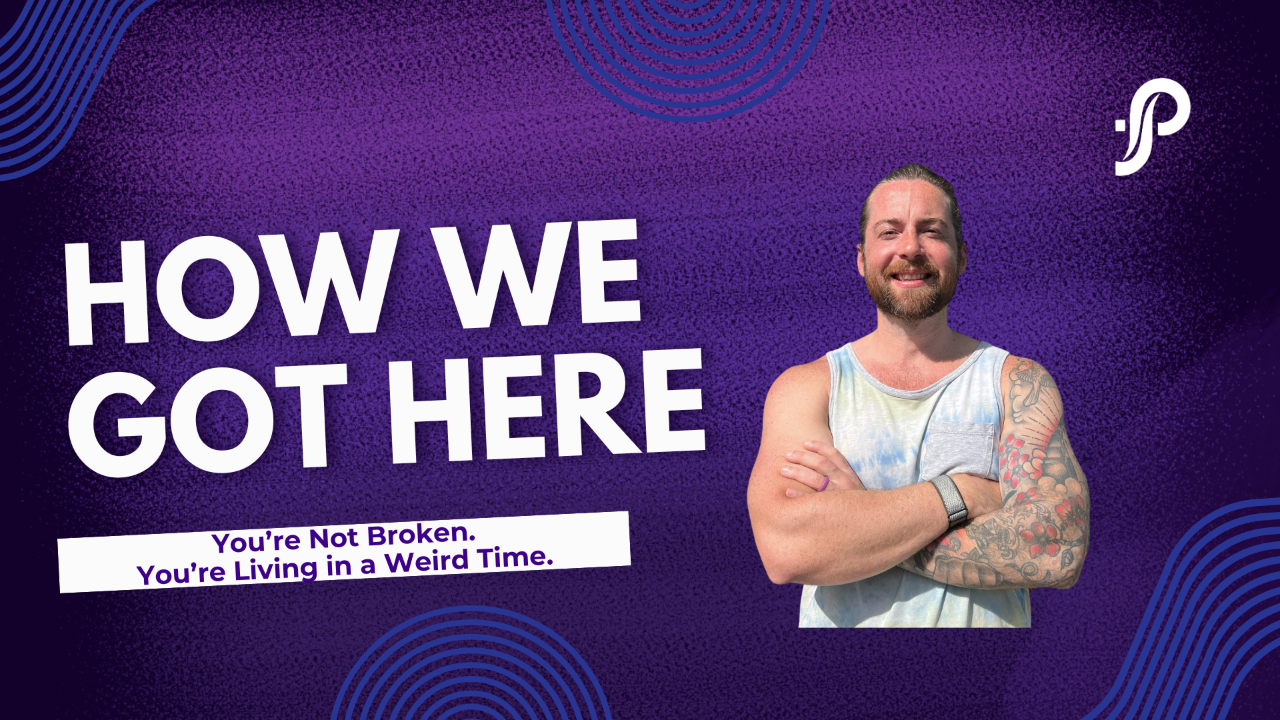
How We Got Here: Chapter 1
May 26, 2026You're Not Broken. You're Living in a Weird Time.
8 minute read
A few weeks ago I caught myself standing in my kitchen eating dinner while simultaneously scrolling Instagram, half-listening to a podcast, and replying to a text message that absolutely could have waited until tomorrow. I had one of those moments where you suddenly become aware of what you're doing in real time, almost like your brain briefly zooms out and goes:
"Dude. What am I doing?"
The thing is, I wasn't even surprised. That's what got me. I've been doing some version of that routine for years and it barely registers anymore. Most people have. You probably know exactly what I'm talking about because you've done it too, maybe this morning, maybe ten minutes ago. Wake up exhausted. Drink caffeine just to feel functional. Stare at screens all day. Eat lunch while answering emails. Listen to a podcast about reducing stress while multitasking six other things. Scroll social media while watching TV. Climb into bed exhausted. Lie there while your brain refuses to shut off the second the stimulation stops.
And somewhere in there, we all just kind of agreed this was normal.
I'm not saying this like I've figured it out or escaped any of it. Half the reason this series exists is because I kept catching myself participating in things that felt genuinely absurd once I paid attention to them. Sometimes I'll be scrolling Instagram and a health and fitness guru pops up explaining how terrible social media is for your attention span while asking me to follow him for more content about dopamine addiction. I'll catch myself nodding along while doing the exact thing he's describing.
What really gets me is that I'm posting online too, because that's just part of running a business now. Everybody knows social media probably isn't great for our brains, but modern life also requires participating in it. Sometimes it feels less like a place you choose to spend time and more like infrastructure you're required to be on.
Something about the way we're living has started to feel genuinely strange. Not in a civilization-is-collapsing way. More like a quiet, nagging sense that we might have optimized a few things we shouldn't have.
Modern life is incredibly efficient. You can answer emails, order dinner, buy a supplement stack for "optimal recovery," doomscroll social media, and watch thirty-second videos engineered by algorithms to hold your attention for as long as possible without standing up from your couch for three hours. Every inconvenience that humanity spent thousands of years trying to eliminate has basically disappeared.
And yet somehow everybody feels like they have no time.
That contradiction has bothered me for years, because time was supposedly the whole point of all this. Faster transportation. Instant communication. Food delivery. AI assistants. Fifteen different apps designed to streamline your life. The promise was always efficiency, freedom, more room in your day for the things that actually matter. Instead it feels like we mostly used the efficiency to cram more things into every available second.
We saved time, and then immediately spent it.
What's become normal is how casually people talk about being exhausted, anxious, burnt out, unable to focus, unable to sleep, constantly inflamed, or emotionally numb, like this is just what adulthood looks like now. Someone mentions they got four hours of sleep, survived on caffeine, stared at a screen for twelve hours, and feel like their nervous system is in free fall, and everyone else just nods.
Yeah man, same.
At some point being busy became a status symbol. People wear exhaustion like proof that they matter. My goal has become basically the opposite. I don't want to feel constantly busy. I want to do meaningful work, spend time with people I care about, and actually feel present for my life while I'm living it. That sounds simple. It's become surprisingly difficult.
The biggest thing I've learned from twenty years of coaching people is that most of them think whatever they're struggling with exists entirely inside themselves. They think they're failing because they lack discipline, or motivation, or mental toughness. Some convince themselves they lost the genetic lottery and feeling terrible is just permanently built into who they are.
Genetics matter. That's real. But I think most people dramatically underestimate how much their environment shapes the way those genetics express themselves. Humans don't exist separately from the world around us. We respond to it, constantly, whether we realize it or not.
Kids are developing health issues that barely existed a generation ago. Adults in their thirties are chronically exhausted. Attention spans feel genuinely fried. Anxiety is everywhere. People are simultaneously overfed and undernourished. Human genetics didn't fundamentally change in the last fifty years.
So it's worth asking what did.
Before this sounds like a screed against modern life, that's not what I mean. Modern medicine is extraordinary. Technology is extraordinary. Air conditioning is extraordinary, especially when you live in Florida and walking to your mailbox in July feels like entering a sauna with mosquitoes. Being able to watch an NBA playoff game while flying across the country is objectively insane in the best possible way. I also very much enjoy not dying from infections that would have killed someone in 1840.
But every system creates tradeoffs. And I'm not sure we've fully processed the tradeoffs of the world we built, partly because everything changed so fast. Humans went from slow, physical, community-centered living to hyper-convenient, indoor, digitally saturated existence in what is basically a blink of an eye historically speaking. Sometimes I wonder if our biology is still trying to catch up to the environment we created.
Sometimes I'll be watching TV and see three commercials back to back that perfectly summarize the whole thing. First a fast food commercial. Then a weight loss drug commercial. Then a beer commercial.
Sell the problem. Sell the solution. Sell another problem.
Food companies want you buying more food. Social media companies want you scrolling longer. News companies want you emotionally activated enough to keep watching. Every app on your phone is competing for tiny pieces of your attention all day. And I think we've been a little tricked by the phrase "social media" specifically, it made entire generations feel like they were connecting socially when a lot of the time they were consuming carefully curated versions of other people's lives. Watching someone talk into a camera for thirty seconds is not the same thing as sitting across from your friends at dinner laughing so hard somebody almost spits their drink out. These are not equivalent experiences.
I'm not looking for a villain in any of this. Blaming an evil mastermind is too easy and too lazy. This is what happens when systems continuously optimize for short-term growth, engagement, and profit without anybody seriously stopping to ask what it's actually doing to people over time. Systems move toward what they reward. Over enough years, those systems start shaping human behavior whether people realize it or not.
Most of the things that help me feel like an actual human being are embarrassingly simple. Going for walks without my phone. Eating meals without a screen in front of me. Moving my body because it feels good. Going to a sporting event and feeling thousands of people lose their minds over the same moment at the same time. Spending a weekend with friends in real life instead of reacting to each other's Instagram stories. Letting myself get bored once in a while instead of immediately filling every quiet second with more input.
Simple stuff. Which might actually be part of the problem. Modern life became so loud and optimized and overstimulating that we started overlooking the basic things that make people feel like people.
That's what this series is really about.
Not wellness culture. Not optimization hacks. Not trying to become some biohacking cyborg measuring your sleep score every morning. Half the biohacking industry is just people rediscovering things humans probably needed the entire time. Sunlight. Sleep. Walking. Eating real food. Somehow we turned "go for a walk" into a premium wellness strategy.
This is more about stepping back and asking how we got here. How did people become so disconnected from basic human rhythms? Why does stillness feel uncomfortable now? Why are chronic health issues exploding while we simultaneously have more health information available than at any point in human history?
The deeper I've gotten into this, the more I've realized that most of these outcomes aren't random. They're connected to incentives, industries, technologies, cultural shifts, and systems that were optimized for profit, engagement, and endless growth, not necessarily for long-term human flourishing. Once you start seeing those patterns, they're hard to unsee.
And here's what I keep coming back to as a coach: most people think the answer to feeling better is inside them. More willpower. Better habits. A stronger mindset. Those things matter. But a lot of what people are fighting against isn't a personal failure. It's an environment that was quietly shaped by forces most people never thought to examine.
That's the investigation. Not a lecture about what you're doing wrong. A genuine attempt to trace how we got here, because I think understanding the path matters if you're trying to find a different one.
Next week, we follow the first clue. It starts with school lunch, a lunchbox economy run by a kid in third grade, and a piece of information I stumbled across that completely changed how I look at the modern food industry.
Because some of the most recognizable food brands in American history had a very unexpected owner.
Stay Connected
I’m Coach Andy, founder of Protean Fitness. Through coaching, writing, and content creation, I explore the connection between modern life, movement, nutrition, stress, recovery, and long-term health.
This series is my attempt to make sense of the modern health world, the systems shaping our habits, and the things that actually help people feel better again.
If you enjoyed this article, you can:
- Join the Protean Wellness Community
- Follow along on Instagram and LinkedIn
If you’re interested in working together or learning more about Protean Fitness, you can visit ProteanFitness.com
Don't miss a beat!
New moves, motivation, and classes delivered to your inbox.
We hate SPAM. We will never sell your information, for any reason.