
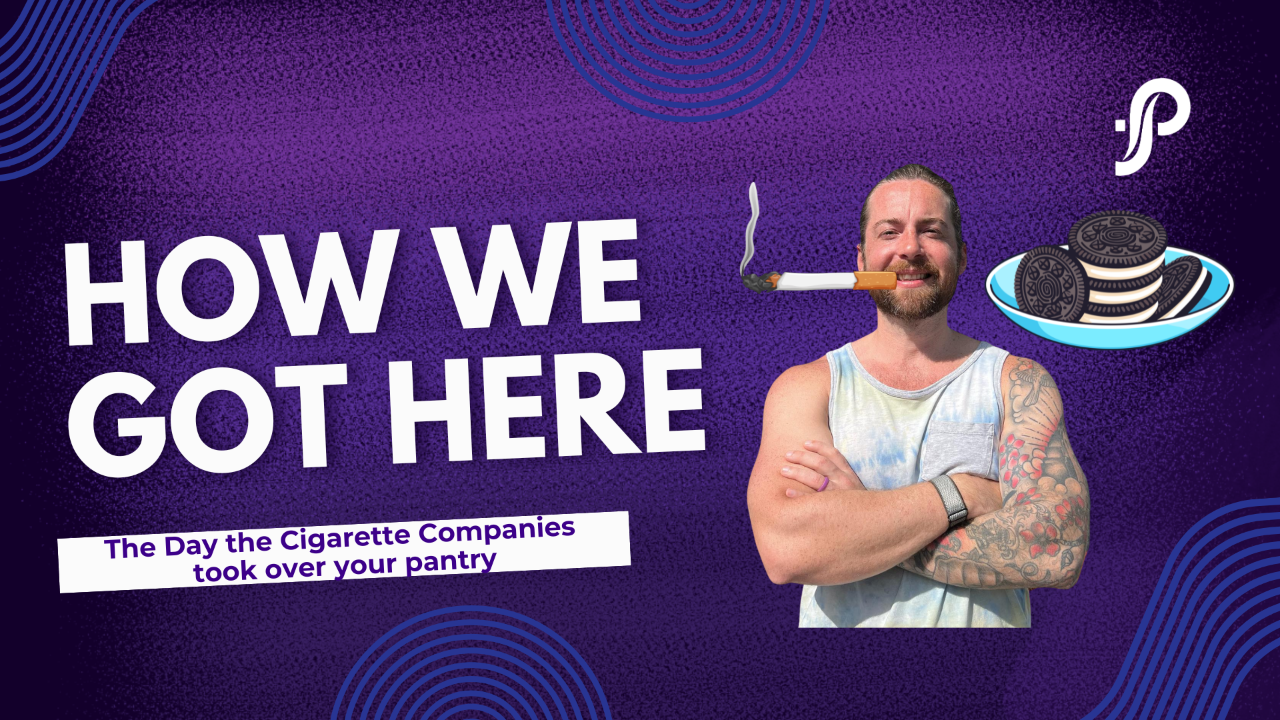
How We Got Here: Chapter 2
Jun 01, 2026The Day Cigarette Companies Took Over Your Pantry
Estimated Read Time: 10 Minutes
Last week I wrote that maybe you're not broken. Maybe you're just living in a weird time. This week I want to show you one of the first things that made me stop and say: wait, what?
Oddly enough, it starts with school lunch.
If you grew up in the 80s, 90s, or early 2000s, you probably remember the food. Lunchables. Capri Sun. Kool-Aid. Oreos. Ritz Crackers. Fruit snacks. Pudding cups. Tiny bags of chips that somehow tasted better when they came out of somebody else's lunchbox. There was always that one kid who had the good snacks. The kid everyone wanted to trade with. The kid running a small black-market economy out of his lunchbox, somehow turning two fruit roll-ups into a package of Oreos and a Capri Sun before recess was over.
Nobody thought twice about any of it. These foods weren't controversial. They weren't viewed as unusual. They were just there, woven into childhood the same way Saturday morning cartoons were. In grocery stores, school cafeterias, Little League concession stands, gas stations, vending machines. If something was being advertised to kids, sold in schools, and stocked in millions of homes across the country, there was an unspoken assumption that somebody, somewhere, had already asked the important questions.
That's the word I keep coming back to.
Normal.
Most parents weren't buying Lunchables because they thought they were health food. They were buying them because they were convenient, affordable, heavily marketed, and available everywhere. The questions most of us never thought to ask were simple ones: who actually owns these products? Where did they come from? What went into making them taste exactly the way they do?
Most people aren't spending their evenings reading corporate acquisition histories. I certainly wasn't. Then one day I stumbled across a piece of information that completely changed how I looked at the modern food industry.
Philip Morris, the company behind Marlboro cigarettes, acquired General Foods in 1985 and Kraft in 1988. Around the same time, R.J. Reynolds, the makers of Camel cigarettes, merged with Nabisco. The tobacco-food connection actually started even earlier, R.J. Reynolds purchased Hawaiian Punch back in 1963, a sugary fruit drink that eventually became a staple in lunchboxes across America. The more I looked into it, the more tobacco companies kept showing up in places I never expected to find them.
Then I started looking at the brands they now owned.
Kool-Aid. Oreos. Oscar Mayer Bologna. Lucky Charms. Tang. Kraft Mac and Cheese. Jell-O. Ritz Crackers. Nutter Butter. These weren't obscure products hiding on the bottom shelf of specialty stores. These were some of the most recognizable brands in America. They were in millions of homes, in lunchboxes, in pantries, in school cafeterias, in grocery carts across the country. Whether anyone realized it or not, tobacco companies weren't buying a small piece of the food industry.
They were buying a seat at the kitchen table.
By the 1980s, public trust in tobacco companies was already collapsing. Smoking rates were declining. Lawsuits were mounting. Americans were increasingly realizing they hadn't been getting the full story about the health risks of cigarettes. Evidence kept accumulating while the industry kept fighting, delaying, minimizing, denying. The American public was starting to understand just how much had been hidden from them.
Which raises an obvious question.
Of all the industries they could have entered, why food?
The more I thought about it, the more the answer made sense. You can quit smoking. You can quit drinking. You can stop gambling. But nobody gets to quit eating. Food is one of the few businesses where every customer has to keep coming back, breakfast, lunch, dinner, tomorrow, next week, next year, for the rest of their lives. If you can create products people enjoy, buy repeatedly, and build into their daily routines, you've created something extraordinarily valuable. Viewed through that lens, food stops looking like a random business decision and starts looking like a natural next move for companies whose previous product was becoming socially unacceptable.
But the ownership story isn't actually the most interesting part.
The more I dug into this, the more I realized tobacco companies weren't just bringing money into the food industry. They were bringing expertise. These were companies that had spent decades studying habits, cravings, branding, consumer behavior, emotional attachment, and repeat consumption. Their entire business depended on understanding why people came back again and again. Every company wants repeat customers, but tobacco companies had spent generations learning exactly how to create them.
That's where I eventually came across a man named Dr. Howard Moskowitz.
Moskowitz was a psychophysicist and market researcher who became known for helping companies understand consumer preferences. He's most often associated with a concept called the bliss point, the precise combination of sugar, salt, fat, texture, and flavor that produces the most enjoyable eating experience. Where is the point, in other words, where people like a food the most?
On the surface that sounds like a perfectly reasonable question. Most people want food to taste good. Nobody is arguing otherwise. But the more I sat with it, the more I found myself thinking about what was actually being studied. Some of the brightest minds in food science weren't spending their days asking how to make people healthier. They were trying to understand what made people want another bite. Then another. Then another.
That's a very different question.
And honestly, that's the moment this story started bothering me. Not because making food taste good is evil, it isn't. Not because eating an Oreo occasionally is going to ruin your health, it won't. What bothered me was realizing how much intelligence, research, money, and effort had gone into understanding consumption. Nobody accidentally eats six chicken breasts while watching Netflix. Nobody finishes three pounds of strawberries and wonders where they went. But somehow finishing a whole bag of chips or two sleeves of Oreos doesn't seem nearly as unusual, despite containing dramatically more calories than either of those examples.
Most people intuitively sense that some foods have a much stronger pull than others. The question is why. The answer, at least in part, is that food companies were actively trying to engineer exactly that pull. And once one company discovered something that worked, every other company had every incentive to figure it out too.
Imagine you're selling crackers. Your competitor develops a product customers like more. Sales increase. Stores give them more shelf space. Market share shifts. What do you do? You compete. Nobody wants to lose customers or explain to shareholders why the other guy is winning. What starts as a business decision slowly becomes an arms race. This is one of those moments where looking for a villain misses the point entirely. The more useful question is: what were the incentives? And once you ask that, the answer becomes pretty clear.
Maybe tobacco companies weren't uniquely evil in this regard.
Maybe they were just ahead.
And once they demonstrated what worked, everyone else followed.
A study published in 2023 found that foods owned by tobacco companies between 1988 and 2001 were significantly more likely to be classified as hyper-palatable than comparable foods not under tobacco ownership. Specifically, tobacco-owned foods were 29% more likely to be fat-and-sodium hyper-palatable and 80% more likely to be carbohydrate-and-sodium hyper-palatable. That doesn't mean tobacco companies invented the concept of making food taste good. It doesn't mean they caused every modern health problem, real life is more complicated than that. What it suggests is that they became very, very good at engineering foods that were difficult to stop eating.
Good enough that researchers could still detect the difference decades later.
It's worth noting that tobacco companies no longer own most of these brands. Philip Morris eventually spun off Kraft. Many of these products went on to become separate businesses under different ownership. Oreo, Ritz, Kraft Mac and Cheese, Oscar Mayer, all now owned by entirely different corporations. But that doesn't change what happened during the decades when tobacco companies did own them, what strategies and incentives they brought with them, or what they may have left behind in the food system long after they were gone.
Around that same period, something else was happening. Processed and ultra-processed foods were becoming a larger and larger part of the American diet. Childhood obesity rates climbed. Adult obesity rates climbed. Type 2 diabetes became more common. Chronic disease became more common. None of those trends can be explained by a single company or a single ingredient. But if we're trying to understand how we got here, it seems strange to ignore the role of companies that spent decades studying cravings, habits, and repeat consumption before becoming some of the biggest players in the food system.
Part of what gets lost in the nutrition conversation is a simple distinction. Calories and nutrition are not the same thing. Calories measure energy. Nutrition is everything else your body actually needs, the vitamins, minerals, protein, and essential fats required to function well. Many ultra-processed foods deliver enormous amounts of energy in small packages while providing relatively little of the rest. That's why eating a thousand calories worth of chips feels completely different from eating a thousand calories worth of steak, potatoes, fruit, and eggs. One delivers mostly energy. The other delivers energy alongside many of the things your body is actually looking for.
The result is a food environment where people can consume more calories than ever while still feeling unsatisfied. In many ways, it's a nearly perfect business model. The customer keeps coming back, but the hunger never quite gets solved.
What sticks with me most about this story isn't what happened to adults.
It's what happened to kids.
Children are adaptable in ways adults aren't. Their brains are developing. Their habits are forming. Their understanding of what food is supposed to be is getting built in real time. The flavors children experience early tend to shape what they consider normal later. Whether intentional or not, an entire generation grew up surrounded by heavily marketed, highly engineered, hyper-palatable foods and simply came to view them as what food was.
Parents weren't nutrition researchers. They weren't studying corporate acquisition histories or reading food science journals or analyzing marketing strategies. They were trying to pack a lunch before work, get their kids out the door, make it to practice, pay their bills, and survive another week. They trusted the system because most people have to trust the system. There simply aren't enough hours in the day to independently investigate every company, product, and industry competing for your family's attention and dollars.
That's probably the part of this story I find hardest to sit with.
The biggest lesson here isn't that tobacco companies bought food companies. That's just the clue. The bigger lesson is that almost nobody noticed. One of the industries Americans eventually learned not to trust quietly became one of the biggest players in the food system, brought decades of expertise in consumer behavior and repeat consumption with it, and somehow this never became a major cultural conversation. Not that it happened. But that it happened with so little public attention.
The takeaway for me isn't fear and it isn't perfection. It's awareness. Understanding how we got here helps make better decisions about where we're going. Read labels. Pay attention to ingredients. Notice what gets marketed to your kids and how. Lean toward foods that don't need a health claim on the packaging to justify their existence, meat, eggs, fruit, vegetables, potatoes, things your great-grandparents would have recognized without any explanation. That's not a perfect rule. But it's a reasonable place to start.
And if you think that story is strange, wait until we get to what happened next.
Because while tobacco companies were studying what made people want another bite, a parallel conversation was happening in government offices, university research departments, and food company boardrooms about what Americans should actually be eating. A researcher named Ancel Keys was developing a theory. The sugar industry was quietly funding studies. And the nutrition advice that would shape an entire generation was starting to take shape.
The tobacco story wasn't the mystery.
It was just the first clue.
Sources
- Addiction Journal: Tobacco-Owned Hyper-Palatable Foods Study (2023)
- University of Kansas Addiction Research Center
- National Library of Medicine (NIH) – Tobacco Industry & Food Marketing
- National Library of Medicine (NIH) – Tobacco Industry & Children's Sugary Drinks
- CDC Data Brief – Ultra-Processed Food Consumption
- Frontiers in Nutrition – Historical Trends in Processed Food Consumption
- Mondelez International Corporate History
- Historical Records on Philip Morris, Kraft, and RJR Nabisco
- Research on Dr. Howard Moskowitz and the Bliss Point
Stay Connected
I’m Coach Andy, founder of Protean Fitness. Through coaching, writing, and content creation, I explore the connection between modern life, movement, nutrition, stress, recovery, and long-term health.
This series is my attempt to make sense of the modern health world, the systems shaping our habits, and the things that actually help people feel better again.
If you enjoyed this article, you can:
- Join the Protean Wellness Community
- Follow along on Instagram and LinkedIn
If you’re interested in working together or learning more about Protean Fitness, you can visit ProteanFitness.com
Don't miss a beat!
New moves, motivation, and classes delivered to your inbox.
We hate SPAM. We will never sell your information, for any reason.