
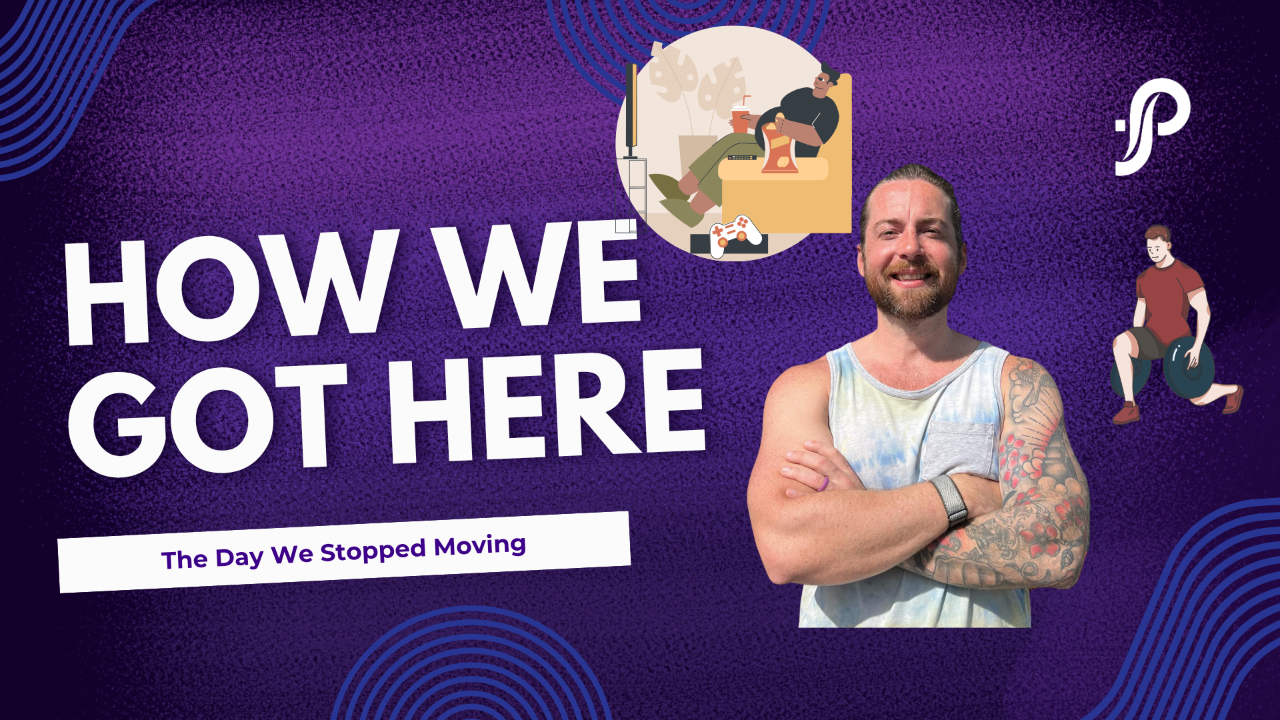
How We Got Here: Chapter 5
Jun 23, 2026The Day We Stopped Moving
Estimated read time: 8 minutes
Last week was about cooking, how preparing food slowly shifted from being a normal part of daily life into something people feel like they don't have time for anymore. A pattern kept showing up that I couldn't quite shake.
As things became more convenient, they also became easier to opt out of. Cooking wasn't the only place that happened.
A few years ago I moved from Washington DC to Florida. There were a lot of reasons for the move, but one thing I didn't see coming was how much it would change how much I actually moved throughout the day.
In DC, walking was just part of the deal. I walked to restaurants, coffee shops, the grocery store, meetings. If I needed to run an errand there was a decent chance I'd cover a mile or two without really thinking about it. Movement wasn't something I planned. It just happened because the city made it happen.
Florida is a different experience. Almost everything requires a car. Grocery store, drive. Coffee, drive. Lunch with a friend, drive. Throw in the heat and humidity for most of the year and walking outside stops being a casual option real fast. Around the same time I also started working from home, and that's when I really started paying attention. Entire days would go by where I answered emails, worked with clients, wrote, took calls, checked every box on my list, and barely left my desk. Those days didn't feel lazy. They felt productive.
That's the strange part.
I've spent nearly twenty years in health and fitness. Movement is literally what I do. And I had to admit to myself that if I don't deliberately schedule a walk, there's a real chance I won't accumulate much movement beyond what happens inside my house. That realization stuck with me because it challenged something I think a lot of people assume, that inactivity is mostly a motivation problem.
I'm not convinced that's the whole story.
The more I paid attention, the more it seemed like the environment itself had changed. Not just for me. For most people. We talk about inactivity like it's a character flaw, people need more discipline, more willpower, better habits. And those things matter. But they don't explain why inactivity became so widespread in the first place. When millions of people are struggling with the same thing at the same time, it's usually worth asking whether something changed around them, not just inside them.
One of the biggest changes happened at work.
In the 1960s, nearly half of all jobs in the United States required at least moderate physical activity. Today fewer than twenty percent do. That's not a small behavioral shift. That's a complete transformation of how most people spend the majority of their waking hours. The American economy moved from factories, farms, warehouses, and physical labor toward offices, computers, service work, and screens. Work didn't disappear. Effort didn't disappear. Physical movement did.
Researchers estimate that occupation-related energy expenditure has dropped by more than a hundred calories per day since 1960. A hundred calories sounds like nothing, nobody gains fifty pounds from a single candy bar. But repeat that every day for a year and that's thirty-six thousand calories. Tiny changes compounding over decades have a way of becoming very large changes.
The same thing happened outside of work. We drive farther and walk less. We shop online instead of moving through stores. We text instead of walking down the hall. Groceries get delivered. Dinner shows up at the door. Entertainment stopped requiring us to leave the couch. Daily life now demands far less physical output than it did two generations ago.
Here's something I think gets lost in the conversation though.
Movement and exercise are not the same thing.
Those words get used interchangeably all the time, but they describe genuinely different things. Exercise is intentional. You schedule it, you carve out time for it, you decide to do it. Movement is broader than that, walking through a city, carrying groceries, climbing stairs, working in a yard, chasing your kids around. One requires a decision. The other just happens as part of living.
This came up constantly when I was training clients in person. Before a workout I'd ask if they'd warmed up. A surprising number of people would say something like "Well, I walked here."
And I always appreciated that, because walking is genuinely valuable and most people should do more of it. But walking to the gym isn't a warm-up. We'd still spend the next several minutes doing dynamic stretches, mobility work, and activation drills because the goal wasn't just movement, it was preparing the body for what was about to happen.
Those conversations made the distinction clear. Walking is movement. A warm-up is preparation. A workout is training. Related, but not the same thing.
Somewhere along the way we started treating exercise as the only form of movement that counts. So people assume that if they aren't working out, they aren't doing anything useful for their health. In reality, some of the most beneficial movement you get all week might have nothing to do with exercise at all.
That realization changed how I think about the fitness industry, and honestly about my own career.
I've built my professional life around helping people move better. I believe in exercise. Strength training has changed my life and I've watched it change the lives of a lot of people I've worked with. If exercise disappeared tomorrow we'd all be worse off. But the irony isn't lost on me that my profession became more necessary partly because movement became less common.
A century ago people didn't need a step counter to remind them to walk. They were already walking. They didn't need a fitness tracker telling them they'd been sedentary all day. Their day wasn't sedentary. They didn't need a gym membership to make sure their body experienced some physical challenge each week. Life handled most of that on its own.
Today an entire industry exists to help people reintroduce movement into lives that don't naturally provide much of it. Gyms, trainers, fitness apps, step challenges, smartwatches, walking programs, home workout subscriptions. None of that exists because humans suddenly became obsessed with exercise. It exists because movement became something we have to deliberately add back in.
Exercise became necessary because movement stopped being automatic.
We tend to assume people stopped moving because they got lazy. But the evidence points somewhere else. Movement slowly disappeared from daily life, and exercise emerged to fill the gap. Those are two very different explanations with two very different implications.
The modern fitness world sometimes feels like a massive effort to recreate conditions that used to just exist naturally. We drive to a building, park, walk inside, and spend thirty minutes on a treadmill. We track our steps because movement no longer happens predictably enough for us to assume we're getting enough. We schedule walks on our calendars the same way we schedule meetings.
When you look at it that way, exercise starts to feel less like the goal and more like the compensation.
Researchers have actually coined a term for this: the "Active Couch Potato." It describes someone who exercises regularly but stays sedentary for most of the rest of the day. First time I read about it I laughed, partly because my old AOL screen name as a kid was CouchPotato13243. Back then it was a joke. Now it's a legitimate research concept.
The term exists because people can go to the gym for an hour and still spend the overwhelming majority of their day sitting. Americans average nearly eight hours of sedentary time per day. That's where phrases like "sitting is the new smoking" come from. The comparison isn't saying sitting is as dangerous as cigarettes. It's pointing out how normalized sedentary behavior has become. Something that would have looked genuinely unusual to previous generations barely registers now.
The challenge isn't that humans forgot how to move. The challenge is that movement no longer has a built-in place in daily life.
That's why walking keeps showing up in health research over and over again. Not because walking is some revolutionary discovery. Not because ten thousand steps is a magic number someone figured out. Walking works because it restores something that quietly went missing. It reconnects movement to everyday life. The body doesn't really care whether movement comes from a treadmill or a walk around the block or carrying groceries up the stairs. It just benefits from being used.
Looking back at this series so far, the same pattern keeps appearing.
Food became easier to get. Cooking became easier to skip. Work became less physically demanding. Transportation got faster. Technology got more efficient. Every single one of those changes solved a real problem. Most of them genuinely improved life in meaningful ways.
But every improvement also changed the environment in ways that weren't obvious at the time.
We didn't stop moving because we got lazy. Life stopped requiring movement. Then we adapted to that reality. Sitting became the default. Walking became optional. Exercise became something you had to schedule. And eventually a lot of people started assuming this was just how things had always been.
It wasn't.
The question isn't why modern humans need exercise. The question is why modern humans need to schedule movement in the first place. Because around the same time we stopped preparing our own food, we stopped using our bodies as often. And then we built entire industries to help us relearn both.
That pattern is becoming harder to ignore.
A challenge appears. Technology solves it. Life gets more convenient. Then a few decades later consequences show up that nobody anticipated.
Food became easier. We lost touch with cooking.
Work became easier. We stopped moving.
The next chapter of this story might be the most important one yet. Because if food companies gradually disconnected us from understanding what we eat, and modern life gradually stopped requiring physical movement, it raises a question that's been sitting in the back of my mind since I started this series:
When did healthcare stop being about health?
And what happens when an entire system becomes better at managing disease than preventing it?
I'm Coach Andy, founder of Protean Fitness. If this series is resonating with you, follow along on Instagram and LinkedIn, or join the Protean Wellness Community
Sources
- Church TS, Thomas DM, Tudor-Locke C, et al. Trends over 5 Decades in U.S. Occupation-Related Physical Activity and Their Associations with Obesity (2011)
- Harvard Gazette. Progress Doesn't Always Mean Movement (2021)
- Biswas A, Oh PI, Faulkner GE, et al. Sedentary Time and Its Association With Risk for Disease Incidence, Mortality, and Hospitalization (2015)
- University of Texas Southwestern Medical Center. How Many Steps Per Day Do You Really Need?
- Why Sitting Too Much Is Bad for Your Health
- Research on the "Active Couch Potato" phenomenon.
Don't miss a beat!
New moves, motivation, and classes delivered to your inbox.
We hate SPAM. We will never sell your information, for any reason.