
How We Got Here: Chapter 3
Jun 10, 2026How We Learned to Fear the Wrong Foods
Estimated Read Time: 9 Minutes
Last week we traced how tobacco companies quietly bought their way into the American food industry and brought decades of expertise in engineering habit and repeat consumption with them. What I found when I kept digging was stranger than I expected.
When I was thirty-one I started having serious gut health issues. The kind that make you wonder if something is genuinely wrong. Chronic bloating, inflammation, symptoms that didn't resolve no matter what I adjusted. I'd spent years working in health and fitness at that point and knew the human body reasonably well, but this was beyond what I could figure out on my own. So I went to get bloodwork done and sat across from my doctor hoping to understand what was going on.
The thing he zeroed in on wasn't my gut. It was my cholesterol. Specifically my LDL, the so-called bad cholesterol, which was elevated. His recommendation was a low cholesterol diet or a statin. I was thirty-one years old, had been lifting weights for years, and was relatively fit despite everything I was dealing with. I left that appointment with a referral and a suggestion to consider medication, without much clarity on the gut issues I'd actually come in for.
I didn't take the statin. But I spent the next several years trying everything I could think of to feel better. Various forms of vegetarian eating, periods of veganism, elimination diets, cutting dairy, loading up on probiotics. Things would improve temporarily and then slide back. The gut issues persisted, sometimes got worse. More appointments led mostly to more conversations about managing symptoms with medication.
What eventually turned things around had almost nothing to do with any of those interventions. I started eating more meat and fruit, focused on sleep, cut alcohol significantly, worked on stress and breathwork, paid more attention to food quality. At almost forty, my gut is better than it's ever been. Foods I thought my body had rejected permanently I can eat again without issue. What I eventually understood was that my gut wasn't healing because my lifestyle wasn't giving it the environment to heal. It didn't matter much what I was eating if everything else was working against recovery.
The cholesterol conversation stayed with me though. Not because the doctor was wrong to flag it, but because I kept wondering where that advice actually came from. Why had dietary fat, and specifically LDL cholesterol, become the thing doctors focused on above almost everything else?
Heart disease doesn't happen in a vacuum. It's a bit like trying to explain why a football team finished 6-11. There usually isn't one reason. Injuries matter. Coaching matters. Conditioning matters. The quarterback matters. Sometimes it's the offensive line. Usually it's some combination of all of it. Human health works the same way. Genetics matter. Smoking matters. Blood pressure matters. Physical activity matters. Stress matters. Sleep matters. Nutrition matters. The problem is that when people are desperate for answers, complicated explanations are often less appealing than simple ones. And in the middle of the twentieth century, with heart disease climbing and families wanting answers, a simple explanation was exactly what emerged.
In 1967, a group of Harvard researchers published a paper in the New England Journal of Medicine reviewing the existing evidence on diet and heart disease. Their conclusion was that dietary fat, particularly saturated fat, was the primary driver of cardiovascular disease. Sugar, they suggested, was not a significant concern.
What the paper didn't disclose was that the Sugar Research Foundation, a trade group funded by the sugar industry, had paid the equivalent of roughly fifty thousand dollars in today's money to fund the review. The researchers had worked closely with the foundation to shape the scope of the analysis. Studies that implicated sugar were downplayed. Studies that pointed at fat were emphasized.
The paper wasn't fabricated. The researchers weren't inventing data. But the framing, the selection of evidence, the conclusions drawn, all of it was quietly shaped by the financial interests of an industry that had a very specific outcome in mind.
Internal sugar industry documents uncovered decades later showed executives explicitly discussing a strategy to shift public and scientific attention away from sugar and toward fat. One memo from 1954 described the potential to increase sugar consumption by getting Americans to eat less fat. The campaign that followed, funded over years and across multiple studies, helped lay the groundwork for what would become the dominant nutritional narrative of the twentieth century.
Dietary fat was the problem. Sugar was fine.
Into that environment stepped Ancel Keys.
Keys was a physiologist at the University of Minnesota, driven, prolific, and absolutely convinced that dietary fat caused heart disease. In the 1950s he began what would become known as the Seven Countries Study, an analysis of diet and heart disease rates across Finland, the United States, the Netherlands, Italy, Yugoslavia, Greece, and Japan. The study found a correlation between saturated fat consumption and heart disease rates across those countries and Keys used it to argue that the science was settled.
What the study didn't mention was that Keys had originally collected data from twenty-two countries. The seven he included showed the correlation he was looking for. Several of the countries he left out, including France and West Germany, had high fat consumption and low rates of heart disease, which complicated the picture considerably. Whether Keys cherry-picked his data or simply made research decisions that happened to support his existing hypothesis is something historians of science still debate. What isn't debated is that the full dataset told a messier story than the one he published.
Keys was also a forceful personality in an era when scientific debates could be won partly through force of personality. Researchers who questioned his conclusions were dismissed, sometimes publicly and unkindly. His influence over the American Heart Association was significant. By the 1960s the AHA was recommending Americans reduce their dietary fat intake. By 1980 the first Dietary Guidelines for Americans had been published, with saturated fat squarely in the crosshairs.
A country that had eaten eggs for breakfast and butter on its bread for generations was about to be told it had been doing it wrong.
What followed was one of the most significant shifts in the American food supply in history, and the food industry saw it coming before most consumers did.
The moment fat became the enemy, manufacturers had a problem. Fat is what makes food taste good. Remove it and you have something that needs to be fixed. The fix, almost universally, was sugar and refined carbohydrates. Products that had been relatively whole became engineered objects, stripped of one macronutrient and compensated with another. But on the label, they wore the right words. Fat-free. Low cholesterol. Heart healthy.
Walk through any grocery store in the 1990s and those labels were everywhere. Fat-free cookies. Low-fat salad dressing loaded with sugar and corn syrup. Fat-free yogurt sweetened to the point of dessert. Reduced-fat peanut butter with added sugar to replace what the removed fat used to do. Margarine instead of butter, made from partially hydrogenated vegetable oils that turned out to cause the very cardiovascular problems they were supposed to prevent. Products that bore no resemblance to anything that had existed in a kitchen fifty years earlier were now being sold as the smarter, healthier choice.
And consumers trusted the labels because they had been taught to. If the label said fat-free, it was better. If it said low cholesterol, it was heart healthy. The macronutrient on the label became the entire conversation, and everything else in the ingredient list went unexamined.
Food stopped being about ingredients and started being about nutrients. Not what is this food, but how much fat does it have? Not is this real food, but does it have enough protein? Not what's actually in this, but does the label say the right thing?
The product itself didn't have to be good anymore. It just had to wear the right label.
Between 1980 and 2000, American obesity rates roughly doubled. Type 2 diabetes rates climbed. Metabolic disease became more common across almost every demographic. This happened during the same period that Americans were, by almost every measure, eating less fat than they had before. The low-fat era was also the era of rapidly deteriorating metabolic health.
That correlation doesn't prove that low-fat dietary advice caused the obesity epidemic. But it does raise a question that took the scientific community an embarrassingly long time to ask seriously.
What if we got it wrong?
The answer came slowly and from the margins. Researchers like Gary Taubes and journalist Nina Teicholz began digging into the original evidence behind the fat hypothesis and found it considerably weaker than its proponents had claimed. The Seven Countries Study's methodological problems became more widely discussed. The sugar industry's funding of early nutrition research became public knowledge. A growing body of evidence suggested that refined carbohydrates and added sugar played a far more significant role in metabolic disease than had ever been seriously acknowledged.
In 2015 the Dietary Guidelines Advisory Committee quietly removed dietary cholesterol from its list of nutrients of concern, reversing decades of official guidance. Eggs, which had been treated with suspicion for a generation, were essentially rehabilitated overnight. The scientific basis for the original restriction, it turned out, had never been particularly strong.
The reversal happened without anything resembling a formal acknowledgment of the scale of the error. Nutrition researchers moved on. Dietary guidelines were revised. New studies replaced old ones in the headlines. Most people absorbed the shift as a vague sense that nutrition science was constantly changing and contradicting itself, not as the recognition that a specific campaign, funded in part by the sugar industry, had shaped public health policy for decades in ways that contributed to a genuine public health crisis.
The pattern didn't stop with fat.
It repeated itself with cholesterol, with carbohydrates, with gluten, with sodium, with red meat. Each cycle followed a familiar structure. A nutrient or food group gets identified as the problem. Fear builds. Products appear that claim to solve the problem by removing or reducing the offending ingredient. Labels replace ingredients as the primary thing consumers pay attention to. And somewhere in the background, financial interests shape which science gets funded, published, and amplified.
Today the label game is more sophisticated than ever. Stand in front of the yogurt section of any grocery store and you'll see exactly what I mean. One container advertises high protein. Another is low fat. Another is zero sugar. Another promotes probiotics. Another claims to support heart health. Another is keto-friendly. Every package has a completely different definition of what healthy means, and every one of them sounds confident. As long as the right words appear on the front, most people don't read what's actually inside. The food industry learned decades ago that you don't have to make food healthy. You just have to make it sound like it is.
I watch this play out constantly with clients. Someone comes in eating what they believe is a healthy diet because everything they buy has the right labels. Low-fat this, high-protein that, sugar-free something else. Then we look at what's actually in those products and the picture looks very different. Artificial sweeteners. Industrial seed oils. Ingredient lists thirty items long. Real food doesn't have a nutrition label because it doesn't need one. An egg is an egg. A steak is a steak. An apple doesn't need to tell you it's gluten-free.
The basics haven't changed much despite all the noise. Eat mostly whole foods. Prioritize protein from quality sources. Don't fear fat. Be thoughtful about refined carbohydrates and added sugar. Sleep well, move regularly, manage stress. None of that is complicated. None of it requires a label.
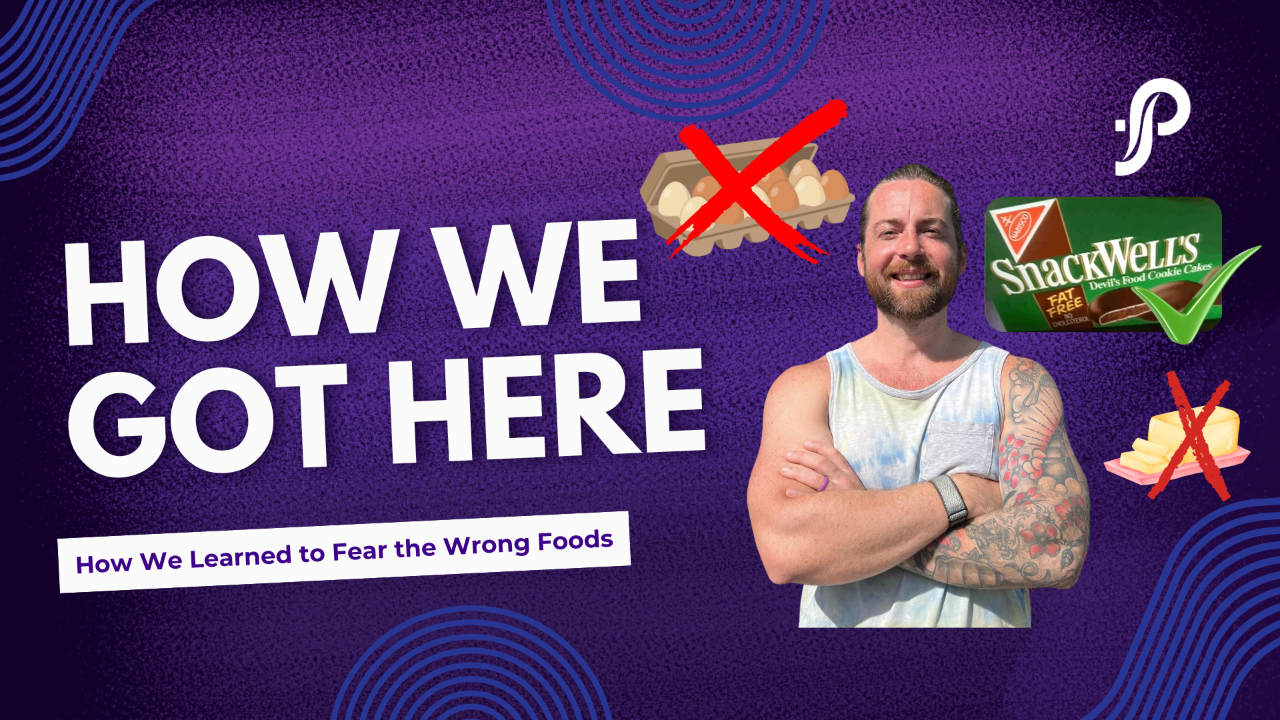
We were told to fear butter and eat margarine. To skip the egg yolk. To choose the fat-free cookie over the real one. Most people assumed that advice came from neutral science. A lot of it came from industries that had something to gain from it.
This story was never really about fat. It was about what happens when a complicated problem gets reduced to a simple headline.
Next week we look at something that happened so gradually most people never noticed it was gone. Not what we were eating. What we were doing. Or more accurately, what we stopped doing.
I'm Coach Andy, founder of Protean Fitness. If this series is resonating with you, follow along on Instagram and LinkedIn, or join the Protean Wellness Community.
Sources
- Ancel Keys and the Diet-Heart Hypothesis (NIH)
- Sugar Industry and Coronary Heart Disease Research (JAMA Internal Medicine, 2016)
- 2015 Dietary Guidelines Advisory Committee — Removal of Dietary Cholesterol as a Nutrient of Concern
- Historical Review of Sugar Industry Influence on Scientific Research
- National Library of Medicine – Dietary Guidelines History
- CDC Adult Obesity Facts
- CDC National Diabetes Statistics Report
- SnackWell's and the Low-Fat Craze
- NOVA Food Classification System & Ultra-Processed Foods
- Ultra-Processed Foods and Health Outcomes Review
Stay Connected
I’m Coach Andy, founder of Protean Fitness. Through coaching, writing, and content creation, I explore the connection between modern life, movement, nutrition, stress, recovery, and long-term health.
This series is my attempt to make sense of the modern health world, the systems shaping our habits, and the things that actually help people feel better again.
If you enjoyed this article, you can:
- Join the Protean Wellness Community
- Follow along on Instagram and LinkedIn
If you’re interested in working together or learning more about Protean Fitness, you can visit ProteanFitness.com
Don't miss a beat!
New moves, motivation, and classes delivered to your inbox.
We hate SPAM. We will never sell your information, for any reason.